Categories
B2B Ethics

Did your client read that Tweet?

Over on Facebook, the Business & Marketing Skills for Therapist Group (here) are helpfully discussing how they can get their message about their practices (etc) out into a wider world.  Some members of the group are professional marketeers, some members are professional therapists.  Something happened to me today that made me notice something that’s essential to therapists as we learn to market our services using public social networks. 

Let me share with you a story…

Tweeting? Twittering? Tweeping?

Over the past month or so I’ve been posting information about counselling on Twitter. I have only 90-or-so followers (compare this with Stephen Fry who has nearly 4 million followers). It’s good fun, it strengthens my reflective practice, it gets me known a little more and brings some new folk to my website.

One might think that 90 people – some of whom are porn stars, one of whom I’m sure is not really a hedgehog, and some of whom seem to hope I’ll be buying their obscure products any moment now – are all who are reading my posts. Maybe not even 10% of the 90 are really reading what I haven’t say.  So little feedback, you see.  So, what might it matter if I might casually slip in a small case example to demonstrate a point in a Tweet?  What harm could 140 characters cause?  It’s only 9-ish people that’ll ever read what I tweeted.

The issue, though, isn’t how few people are reading me (or you, dear fellow therapist, once you hit that Tipping Point).  The issue is that once my post goes into the world, anyone can get at it. 

Any.

One.

Do you know who reads your tweets?

Today, I was surprised (though delighted) to find that some of my Tweets have begun appearing in online newspapers recently. Surprised because these are online resources that I do not follow, they don’t follow me, and I haven’t sent them any of my tweets.  But they’ve still gotten hold of them (“public”, remember!). 

By some mathem-agical power of the InterWeb, my little tweets have somehow spread out into the big, scary world and, by chance more than design, have gotten included in publications that I’ve never heard of.  My words are circulating around (at least for 24 hours until the next publications go out tomorrow, at least).

How thrilling!!

But, can we return back to that little case example I might have Tweeted about?

I put to you – dear ethical reader – the query…

…what if one of the readers of these online papers happened to be the client that I referred to in my Tweet?

What if he recognised himself?

What damage would I have done by, perhaps imagining that non of my followers had anything to do with my client; that they were the only ones who would have read my misplaced comment* ?

Ethics & Marketing.

In the Facebook group earlier discussed, therapists and skilled marketers are passing around valuable information on how a therapist might get their message out there into the world.  I would suggest to you that sometimes it happens – and when it happens BOY does it get far and wide out there.

Marketing experts will teach us therapists these things… but the ethics in what we, as therapists, put out there are entirely our responsibility … and ours alone. 

Anonymising a case is not the same as protecting its confidentiality.

And anything you write on the Internet is not private :p

I’ll leave you with that thought.

Comments are welcome, below, but preferably back on the Facebook group if this is where you found this post.

Just to clarify – I don’t discuss online/in public forums any current case work at all.  When demonstrating a point, I tend to make references to generalised examples or to casework that is already in public circulation (eg a case discussed by Patrick Casement in one of his books) .


Categories
FAQ

Can I send someone to see a counsellor?

Sometimes, people see counselling as a last resort.  Something that is to be tried after everything else has been tried (and failed) … to fix someone else.

It is not unusual to find that people can think of counselling as something that they want to send someone to:

I want to make an appointment for my husband.

I think my friend needs counselling, will you see her?

Can we send our sister and her boyfriend?

My husband and I want to send our son for counselling.

My mother is upsetting the family, will you see her for counselling?

Counselling is a form of therapy that is private & confidential.  It can help people address personal problems (and problems within relationships):

  • It can help address ways of thinking (such as a cognitive-behavioural approach (CBA)) so that the person can be less restrained by their thoughts.
  • It can help address issues from the past (such as a psychodynamic approach) so that the person can be free of past bad experiences.
  • It can help address relationships (such as a systemic approach) so that a couple are less restricted by the same patterns of relating over and over again.

But… counselling is a personal resource, a form of assistance, a help. You are an equal-participant in counselling; counselling is not something that is done to you.

Counselling is not done to someone.

– and counselling does not “fix” someone for someone else’s benefit.

  • Counselling is a collaboration that you (and your partner if couples counselling) willingly take part in along with the counsellor;  it is a therapeutic and professional relationship.
  • Counselling cannot be something you send someone to (even if all else has failed) with the hope that the someone will be cured/fixed/made-acceptable-to-you once the counsellor has “dealt” with them.
  • A person – or both partners in a couple-relationship – has/have decide for himself/herself/themselves if he/she/they want to participate in the counselling process for himself/herself/themselves.  

… and sometimes a person does not want to change, no matter how unacceptable someone else may consider this.  Being sent to counselling won’t do any good if the person has no interest in changing something.

Counselling and Couple Relationships.

Sometimes a couple comes into counselling and one (or both) partners spend a lot of time and emotion telling me how the other partner is the problem.  They will point out all the problems with what their partner does and says.  They will imply – or even say quite clearly – that I (as the counsellor) should be fixing the partner (implication: so that the complaining partner is no longer upset).

The couple counsellor focuses on the relationship – not he individuals.  As they say, “it takes Two to Tango”, so it also takes two to make a problem.  Although the complaining partner may feel as though they are not part of the problem(s), a systemic point of view would be to consider that both partners are contributing to the problem(s) existing.  The couple counsellor will help the couple to discover how their relationship is contributing to – and keeping alive – the problems, and will help the couple … both partners … to perturb their relating behaviour enough to invite changes to happen … checking that this is what the couple wants.

In this example – you may notice that the idea of one partner sending the other partner to be ‘fixed’ may not be a very good solution to a relationship problem.

(For more information on couple counselling, use the Counselling Menu at the top of the page…)

Hoping to send someone to counselling.

So, when someone contacts me asking:

“…can we send so-and-so because they need counselling…?”

my response will be of the form:

“The person [or couple] is very welcome to make contact with me themselves and we can discuss matters”.

Clearly, there may sometimes be circumstances when a person cannot contact me on their own (phobia against using the telephone or email etc.), and we can be creative in this respect.  Perhaps using a third party for communication where appropriate.  However, the same guidelines apply: if a person or couple have not decided to come to counselling themselves, there is nothing I can do to see someone on behalf of another person’s needs.

Alternatively, maybe you might like to come and meet with me on your own to discuss with me how you might find some support in your struggles to manage with someone else’s problem.

Categories
B2B

First VistaPrint Order

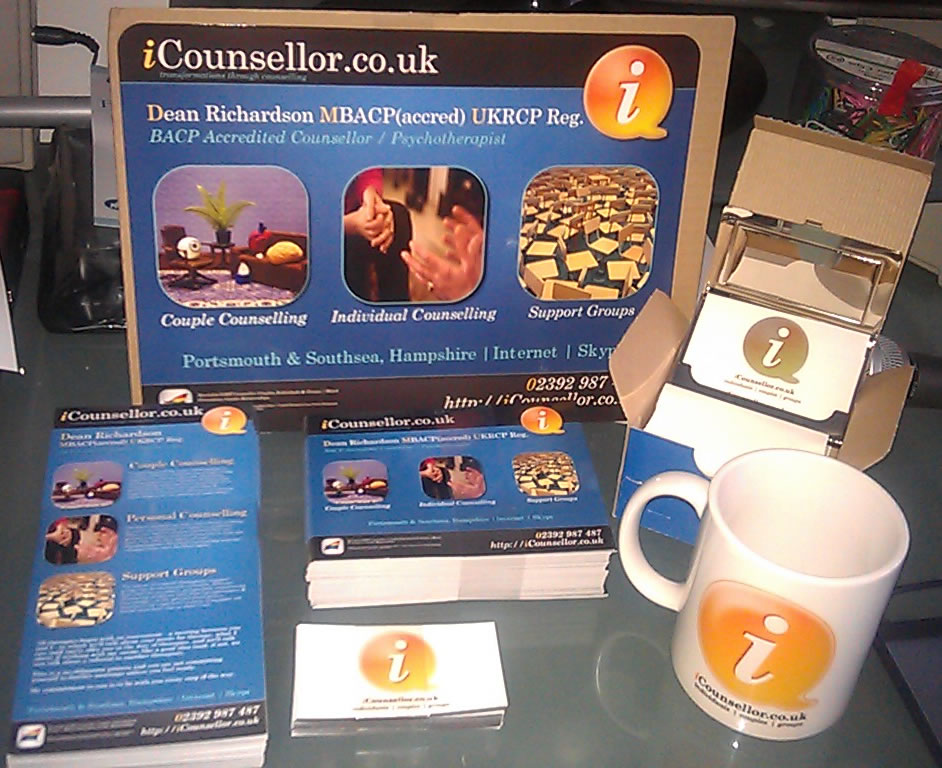
A few days ago, I promised the “Business and Marketing Skills For Therapists” group on Facebook a report on my first order from VistaPrint.

A description follows, and photographs are below.

Background.

I’ve been designing my own marketing material for some years, now, but whilst some of the paper one can obtain from Staples, PC World etc is of very good quality, some of the features of the media is lacking.

For example, glossy paper can only be printed on one side (print on the other side and the ink literally slides slowly off the paper as the print comes out of the ink jet printer!), heavyweight paper (280gsm) is reasonable for Rack Cards, but the equivalent in business cards feels a little flimsy and wrong.

The Project!

Use VistaPrint to upload my own designs, following their guidelines to the letter, take advantage of their many special offers, and see what things are like when I open the box upon arrival.

Conclusion.

I’m 90% happy.

Costs ended up as feeling reasonable – I was advised by a colleague to order the items but not pay for them – and wait for at least three offers of discounts by email.  In doing so I paid around £60 and saved around £150 – however, I’m not entirely convinced that these marketing items would have been worth £210 – suggesting to me that VistaPrint may artificially inflate their prices in order to give discounts.  Just my opinion.

Positive:

All the items “feel” right & (mostly) look right.

Colours look wonderful on most things and the “feel” of the items are what I’d expect when I pick them up (one gets a sense of something as being “cheap” or “quality” by their feel, and I get a “90%” feel of quality with all the items).


Negative:

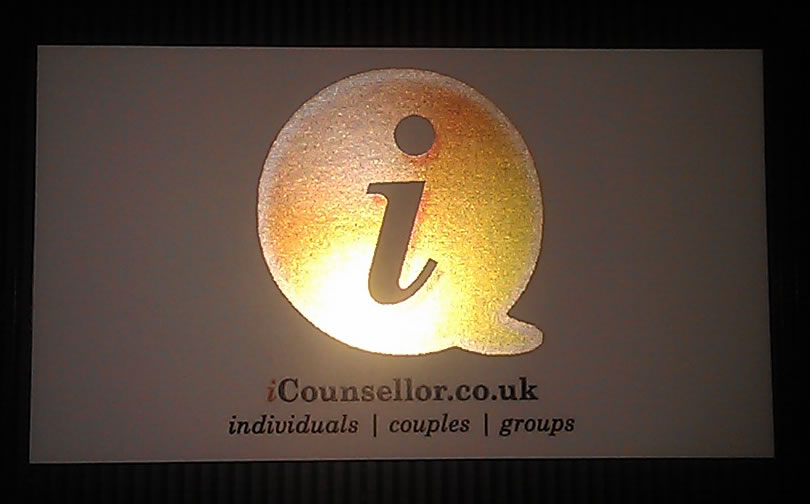
Foil: I choose to have “foil” business cards (which adds a layer of shiny metallic to areas of your card).  VistaPrint says: “When any colour ink is applied over the foil it creates a brilliant highlighting effect that seems to change colour. Your cards are distinctive and your designs really stand out.”  However, whilst the foil does make the card look “oooh shiny” it has also dulled the colour of my logo to the point of being drab.  I use highlights and gradients in my logo and the foil layer washes these subtleties away.

Packaging: VistaPrint wrapped most “multiple” item (eg 250 business cards) with a plastic band, and put every “banded” collection in an oblong box along with the mug wrapped in cardboard and the business cards in a separate box.  They added a couple of “air bags” to supposedly protect the items.  No way did this protect any of the items and the box bounced and rattled its way to my home.  Most of the items (eg postcards) have a slightly “damaged” feel to the edges – which may have been caused by the packaging, or may have been caused by a not-very-sharp cutting tool when it came off the printing press.


What would have made me 100% happy?

  • Sharply cut, neat edges on postcards and rack cards.
  • My business card’s “foiled” logo being as brilliantly coloured as on all the other items.
  • Professional packaging to protect all the items.

Photographs.

(Click the image to show larger version)

 All the items ordered from VistaPrint

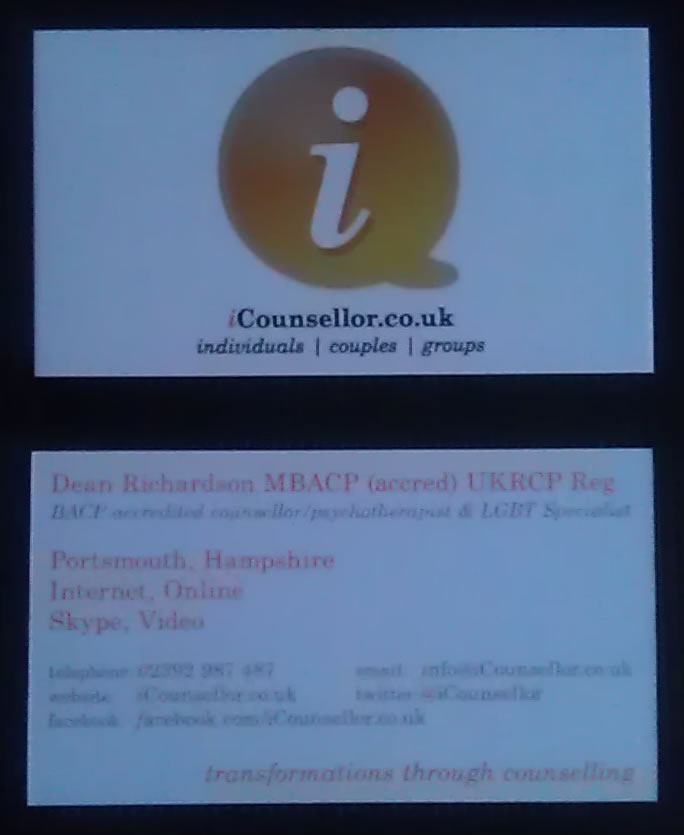
 Business Cards
Front: Colour, matt (silky feel), foil around logo.
Back: Colour, matt (rougher feel)

 Business Cards
Demonstrating the foil around the logo

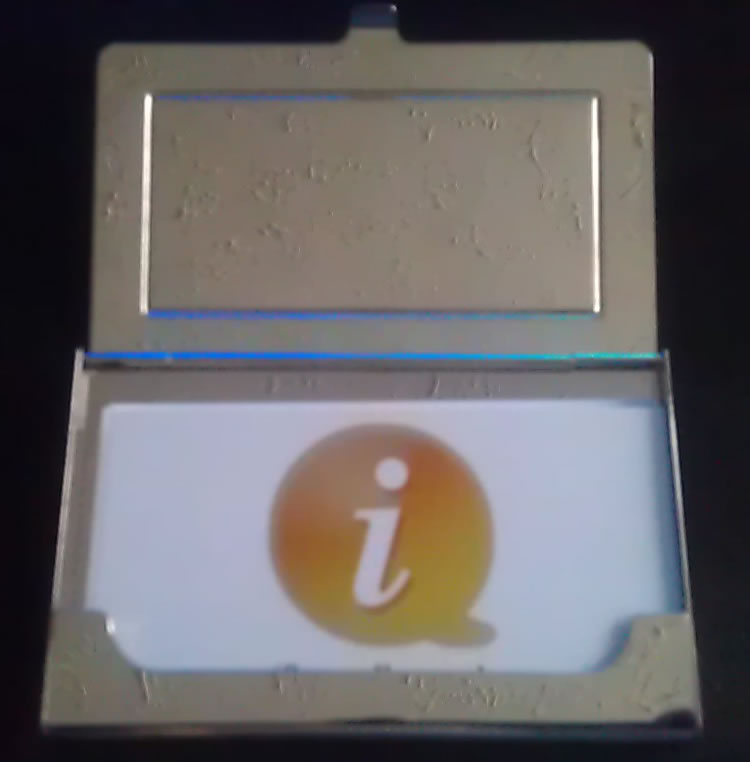
 Business Card Holder
Metal holder – holds about 25 cards.

 Rack Cards
Front: Colour, glossy.
Back: Colour, matt.

 Postcards
Glossy front (grey scale on the back – not shown)

 Car Magnet
Small sized magnet to go on card door.

 Mug
I couldn’t resist just buying the one 😀

VistaPrint can be found at http://www.VistaPrint.co.uk/

Categories
Articles

How to Find & Vet a Counsellor

How to Check if a Counsellor is Legitimate.

Counselling, Therapy & British Law.

A current problem (2011 when I wrote this article, and still current in 2014) in British Law is that counselling, psychotherapy, hypnotherapy, spiritual/religious counselling, alternative therapies (and so on) are not regulated by law. 

Anyone can set themselves up as a “therapist” or use the word “counsellor” without (legally) requiring any formal therapeutic qualifications to prove their ability to practice as a counsellor.

This situation leads to counsellors not being required have to have any insurance.  They don’t have to be answerable to a professional body to oversee their practice.  These therapists can advertise themselves as a “counsellor” without actually having any training, qualifications, nor any actual experience as a professional intended to help you therapeutically.

Some organisations use ‘counsellor’ in forms such as “Travel Counsellor” or a “Debt Counsellor” – and by the true definition of the word counsellor they’re not intending to mislead the public into thinking they’re offering a therapeutic approach to your mental well-being.

Unfortunately, by the lack of British law, that the responsibility lays on the client who is seeking counselling/therapy to find someone who is appropriate for their treatment.

Going through a GP may not be enough (limited to offering only NHS IAPT treatment … often with a waiting list) to gain access to suitable counsellor. 

All of this can leave a person at risk when trying to find a counsellor who is not an unqualified fake.

Help in Finding a “safe” counsellor.

There is good news, though.

Finding a qualified, experienced, professionally accredited and insured counsellor can be straightforward if you know some helpful things to look out for. This article describes how to find a suitable counsellor – and offers some topics to check out with your potential therapist.

At your first meeting with your counsellor, most – if not all – counsellors should not be phased by you asking about any of these topics (in later sessions, however, certain therapists may not answer questions about themselves, but be interested with you in the purpose of your question – keeping the focus upon you.  This is a legitimate approach to some forms of counsellor (i.e. psychodynamic / psychoanalytical) but I mention it here for your knowledge).

Search Counsellors’ Professional Bodies’ Online Directory.

An easy way to find a suitable therapist is to use a professional counsellors’ body that offers a “find a counsellor” type of service. The counsellors listed may have had to pay for an entry, but would also have had their qualifications checked before being allowed to pay for an entry in the list.

… however, if you wish to find your own counsellor – or you would like some advice on what to check out about your potential counsellor – then click the next page for…

“The iCounsellor’s Guide to Finding a Counsellor“.

Categories
Statistics

I’ll show you how Counselling Improves Well-Being (CORE)

CORE-34 Statistical Evidence shows Counselling Improves Well-being.

This article discusses how the use of a survey containing 34 questions (called “CORE-OM”) allowed me to demonstrate that counselling can improve psychological distress. Four psychological areas are measured

CORE-34 Measures Four Psychological Areas.

  • Well-being
  • Symptoms
  • Functioning
  • Risk states (eg self-harm)

History of the iCounsellor.co.uk (2009/10) CORE Survey.

The survey was taken during the period 2009-2010 and with clients’ permissions. All clients were British and between the ages of 22 and 49. Firstly, the survey was offered at the second session (rather than the first as clients are particularly more anxious than usual during the first session and this tends to skew results). Counselling commenced as it would usually. The survey was offered a second time during a session in the ending period of therapy and the information shared with the client.

The statistical information showed that psychological improvements are recorded during the period in which the person was in counselling.

What is CORE-OM?

Clinical Outcome Measure

Initial Distress Levels
Final Distress Levels
[Severe][Low Level]
[Modererately Severe][Mild]
[Moderate][Healthy]
[Mild][Healthy]

The table above shows that the individuals who took up counselling with Dean Richardson/iCounsellor.co.uk during 2009-2010 experienced improvements in their distress levels (data is taken anonymously from actual client data CORE forms and used with permission). CORE measures improved levels of distress in such areas as well-being, symptoms/problems, life-functioning and states of risk/harm.

Clients achieving a reliable improvement:100%
Clients achieving no change:0%
Clients deteriorating:0%
Average number of sessions: 
Meridian average:7.0
Mean average:10.4

The CORE Outcome Measure (CORE-OM) is a client self-report questionnaire designed to be administered before and after therapy. The client is asked to respond to 34 questions about how they have been feeling over the last week, using a 5-point scale ranging from ‘not at all’ to ‘most or all of the time’. The 34 items of the measure cover four dimensions: subjective well-being; problems/symptoms; life functioning; and risk/harm. The responses are designed to be averaged by the practitioner to produce a mean score to indicate the level of current psychological global distress (from ‘healthy’ to ‘severe’). The questionnaire is repeated after the last session of treatment; comparison of the pre- and post-therapy scores offers a measure of ‘outcome’ (i.e. whether or not the client’s level of distress has changed, and by how much).

For further information on CORE, including downloadable CORE forms, see the CORE-OM website.

How client and therapist use CORE together.

CORE-OM Scores & Severity Levels

140   Severe (85+)
130    
120    
110    
100    
90   Moderate to Severe (68-84)
80    
70    
60   Moderate (51-67)
50    
40   Mild (34-50)
30    
20   Low level (21-33)
10   Healthy (0-20)
0    

Distress Severity Levels

Some therapy agencies and therapists use CORE as part of the assessment. For me, it is an optional part of my counselling procedures. A client may wish to take the CORE survey at the start & end but they do not have to participate in the survey. The survey is not offered to couples in couple counselling because couple counselling works on the relationship, not two individuals (and CORE does not measure distress levels of a relationship, only the individuals).

CORE can therefore be used as part of a “tool-kit” to complement not only the counselling experience but to give the client something visual and measurable.

CORE is not a tool for a complete diagnosis. Rather, one might think of CORE a little like a room-thermometer; the thermometer might indicate if the room could benefit from more heat being added but, in reality, it’s the people within the room who will decide if they require more warmth. CORE therefore may suggest an improvement has or has not been recorded, but it’s the client him/herself who’s opinion matters.

When used, the CORE survey takes about five minutes to complete, and is done in the counselling room. When completed, I summarise the most important details and discuss with the client about what the survey reveals to us. This can often be a useful source of topics to discuss in counselling. Near to the end of our counselling work, another survey allows us to compare how the client was in the past with how they are now.

What the iCounsellor.co.uk (2009/10) CORE survey demonstrates about Counselling.

By using CORE, clients and I were able to demonstrate statistically that a person’s psychological well-being, symptoms, life-functioning and states of harm or risk were improved during the counselling process.

For practitioners to assess meaningful improvement over the course of therapy, two measurements are important: reliable change and clinically significant change.

  • Reliable change is change that exceeds that which might be expected by chance alone or measurement error, it is represented by a change of 5 or more in the clinical score.
  • Clinically significant change is indicated when a client’s CORE score moves from the clinical to the non-clinical population (eg a CORE score of around 10 or below).


Update November 2013: I thought it important to add this note to clarify that as a counsellor working with individuals I no longer use CORE in my practice (and I never used it with couples … as CORE is unable to measure a relationship).  CORE statistics are helpful to those who are seeking to prove a position (such as seeking funding, or demonstrating an outcome of using a particular model of therapy, for instance).  For clinical work, however, I have found that it’s the relationship between client and counsellor that is far more important in discussing & determining outcome… and a reflection of a client’s state of mind using numbers can be less than helpful. 

© Article Dean Richardson 2010.

Categories
FAQ

How do Support Groups End?

This FAQ is about support groups.  For information on ending counselling – individual or couples click here.

Support Groups.

The type of ending will depend on the type of support group you are in:-

  • Open/Ongoing groups: group members depart when they have no longer a need for what the group offers. It can be helpful to the group and the individual if the individual first discusses their desire to leave the group before they actually do.  Subsequently, an ending date can be agreed giving the group and the departing member an opportunity to work through the ending and to say goodbye.
  • Closed/Fixed term groups: the group starts with a predefined set of objectives and group members that work for a set number of sessions or goal(s). The intention here is that all group members end at the same time.  Sometimes this is not possible and an individual is free to leave the group as they need to.  It can be helpful to the group and the individual if the individual first discusses their desire to leave the group before they actually do.
Categories
Ethics

My Counselling Ethical Framework

BACP Ethical Framework.

Dean Richardson is a BACP Accredited Counsellor / Psychotherapist (explanation of qualifications).  I am a member of the British Association for Counselling and Psychotherapy (BACP). The accreditation means that the BACP have authenticated my substantial level of training and experience to be working as a counsellor / psychotherapist. Appropriately, my counselling work adheres to the BACP’s Ethical Framework (click to read BACP’s statement on Ethics for Counselling and Psychotherapy).

The BACP can suspend, deregister or remove accreditation from member counsellors/psychotherapists who fail to perform their work to the highest professional standards and/or who contravene the BACP’s Ethical Framework.

If you have a complaint or dissatisfaction about the therapeutic service I am providing for you, it may be helpful for you to you raise your concerns initially with me.  We will try and address the matters together.  If we cannot resolve the matter together then the BACP can provide help and assistance to you if you wish to take the complaint further (read more…).

BACP Address.

British Association for Counselling & Psychotherapy,
BACP House,
15 St John’s Business Park,
Lutterworth,
LE17 4HB.

Tel: 01455 883300,
Fax: 01455 550243,
Minicom: 01455 550307,
Text: 01455 560606

http://www.bacp.co.uk/

Categories
Uncategorized

Welcome to iCounsellor.co.uk

Hello!

iCounsellor.co.uk is the website for Counsellor Dean Richardson MNCS(Accredited Registrant) – an National Counselling Society accredited and registered counsellor / psychotherapist practising privately on the south coast of England in Southsea, Hampshire.

NB: this website broke during transition to a new server. The Internet Elves are working on fixing things. In the meantime, it might be best to pop along to one of the other working websites:-

With best wishes,
Dean Richardson.

Categories
Humour

Siri for iPhone 4S – Not a Couple Therapist

Siri – the voice-interactive iPhone application.

Many of you will have seen the latest iPhone 4S advertisements.  People speak into the phone, and Siri makes an intelligent-sounding reply.  Siri can also amend your calendar, make a call, and send messages on your behalf.  Siri is very helpful – but I suspect that as a couple counsellor Siri would not have the appropriate skills to help a couple in conflict…

See all the CollegeHumor Original Videos here.

Just for clarification – this is humour – but whilst the couple is played by actors, and the situation is meant as comedy, many couples may hear a tinge of reality in the argument.  Take heart – this is meant as being light-hearted – but if you and your partner are in a conflicting relationship and you both would like some serious help, contact Dean Richardson for assistance.

Categories
FAQ Individuals

What Happens in Individual Counselling?

What Happens in the First Counselling Session.

The first session is called the assessment. Before you and I begin therapy, we must be sure:

  • Is therapy is right for you?
  • Is working with me and my style of therapy the right thing for you?
  • Do we both think that our working relationship could be good enough to work in therapy together?
  • Are there any mental issues that might make counselling difficult (or impossible) with me.

What Happens in Subsequent Counselling Sessions.

How it can help you.

You (and your partner if couples counselling) and I sit opposite each other, chairs at slightly an angle, and we have conversations. What we talk about is up to you, and what we discover during our conversations can be revealing, helpful, and life-transforming. Sometimes matters that are difficult to talk about with others can become easier to talk about with me. I don’t talk about our conversations with anyone else – so our therapeutic relationship becomes trustworthy.

Other sites of interest: Counselling via Skype, Online Zoom Counselling, Havant Counselling & Online Counselling for LGBTQ+ Partners.